


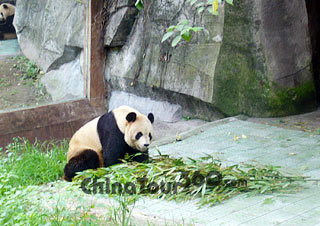
 A Lovely Panda in Chongqing Zoo
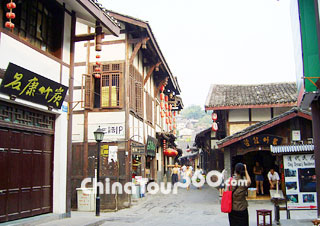 Ciqikou Ancient Village
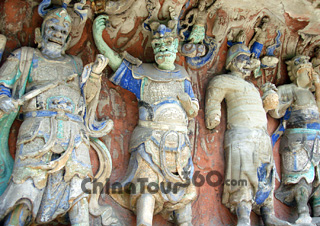 Dazu Grottoes
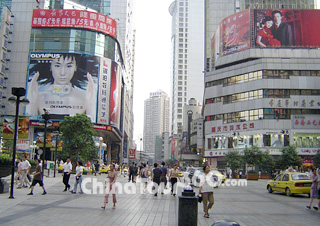 Jiefangbei Commercial Street
 Facts
Facts
Phone Code: 023
Postal Code: 400000 - 409912
Area: 82,402.95 square kilometers (31,815.96 square miles)
Population: 32.35 million (2007 statistics)
Nationalities: Han, Tujia, Miao
Neighboring Areas: Hubei, Hunan, Guizhou, Sichuan, Shaanxi
Location: Chongqing is located at the southwestern part of China, between the developed eastern area and the western area of rich natural resources. Its longitude lies between 105°11′- 110°11′E and latitude between 28°10′- 32°13′N.
Physical Features: Chongqing lies to the southeast of Sichuan Basin, which is also the transitional area between Tibet-Qinghai Plateau and the Middle and Lower Reaches Plain of the Yangtze River. Surrounded by the mountains on the south, north, and east, it is mostly covered by hills and mountains. Therefore, people nicknamed it “The City of Mountains”.
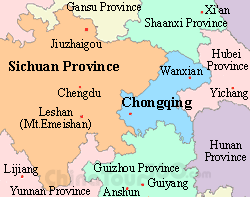 |
| Chongqing Maps |
History:The earliest human traces found in the area date back to 20 to 30 thousand years ago. In the 11th century BC, the Ba people established the Ba Kingdom and made it the capital. It was named Ba County in the Qin Dynasty (221 BC - 207BC) and later the named was changed to Chuzhou during the Southern and Northern Dynasties (420 - 589). In the Sui Dynasty (581 - 618), Sui Wendi changed Chuzhou to Yuzhou, and since then it has been called “Yu” for short. In 1189, Song Guangzong, the third emperor of the Southern Song Dynasty (1127 - 1279), was entitled the Prince Gong (the prince of Gongzhou), and then ascended the throne from his father Song Xiaozong. Considering the two happy things in his life, Guangzong changed the name of Gongzhou to Chongqing, literally meaning "double happiness”. During the Sino-Japanese War, Chongqing Municipality functioned as a secondary capital of the Republic of China. It did not become a city of Sichuan Province until 1954. In 1997, it was approved to be a municipality by the National People’s Congress of China.
 Recommended Tour Itineraries:
 4-Day Yangtze River Cruise: Chongqing - Yangtze River Cruise - Yichang
China Yangtze Cruise Tour: 15 Days of Beijing - Xian - Chongqing - Yangtze River Cruise - Yichang - Shanghai - Guilin - Yangshuo - Guilin - Hongkong
China Small Group Tour: 11 Days of Beijing - Xian - Chongqing - Yangtze River Cruise - Yichang - Shanghai
Attractions Traveling in the city, you will experience both the natural beauty and its splendid cultural heritages. People's Liberation Monument (Jiefangbei) is one of the symbolic constructions in the city. The People's Assembly Hall built in the style of Ming and Qing Dynasties is one of the 43 classical buildings in China. Dazu Rock Carvings are the religious rock carvings of the late Tang and Song Dynasties. The Porcelain Village (Ciqikou) is an ancient village in the style of the Ming and Qing dynasties, where you can find interesting local handicrafts, delicious snacks, and the excellent folk shows. In the China Three Gorges Museum, you will learn the culture and knowledge of the Three Gorges and the magnificent Three Gorges Project. The General Joseph W. Stilwell Museum exhibits the pictures and items about Mr. Stilwell, an American General who made great contributions to the liberation of China during WWⅡ.
The city is also the starting point of Yangtze Cruise Tour, embark from the Chaotianmen Ferry Terminal and cruise downstream along the Yangtze River. Wonderful scenery and famous historical sites will be unfolded in front of you, including the Qutang Gorge of the Three Gorges, Twelve Peaks of Mt. Wu, Three Little Gorges, the White Crane Ridge in Fuling, Fengdu Ghost City, the Precious Stone Fortress (Shibaozhai) in Zhong County, and Zhangfei Temple in Yunyang County.
Transportation:  Air: There are three airports in the city, the Jiangbei International Airport, Wanzhou Wuqiao Airport, and Qianjiang Zhoubai Airport. The Jiangbei International Airport now operates international flights to Tokyo, Doha, Bangkok, Phuket Island, Taipei, and Hong Kong. Domestic flights to major Chinese cities such as Beijing, Shanghai, Xian, Guangzhou, and Chengdu are available in all three airports. See Chongqing Flight Schedules. Train: There two railway stations in the city, the Chongqing Railway Station and the North Railway Station. Chongqing Railway Station, also named Caiyuanba Station, mainly operates the trains to Sichuan, Guizhou, and Hunan areas. The North Railway Station, newly opened in 2006, operates most trains traveling from/to Chongqing. See Chongqing Train Schedules Subway: Subway Lines 1, 2 and 3 of the city are now in use. Line 1 runs between Chongtianmen and Three Gorges Square, Line 2 between Jiachangkou in Yuzhong District and Xinshan Village in Dadukou District, and Line 3 runs between Ertang in Nan’an District and Jiangbei International Airport. Subway Line 6 is under construction and should open in 2012. Bus: Buses to cities or towns in neighbouring provinces operate from 7 long-distance bus stations: Chongqing Long-Distance Bus Station, Northern Long-Distance Bus Station, Chaotianmen, Longtousi, Maoping and Chenjiaping long-distance bus stations. Intercity Bus: Over 300 bus routes connect almost every corner of the city. The BRT Express Bus, put into service in 2009, runs between Longtousi Bus Station and the Hong Kong Town in Dadukou District. Ferry: Chongqing is an important port on the Yangtze River waterway. You can enjoy the beautiful scenery of Yangtze River on the way to the port cities along the river, including Yichang, Wuhan, Nanjing, and Shanghai. Most ferries depart from Chaotianmen Ferry Terminal. Weather
 The city has a mild subtropical monsoon wet climate with a warm winter (November to January of the next year) and a hot summer (June to August). The city has plentiful rainfall over the year, especially during the months between spring and summer (April, May and June).
Dining and Shopping: The local cuisine features spicy and hot and the most famous food is Hotpot. Famous Hotpot Restaurants in the city are: Hongding Meirenmei Hotpot Restaurant near Hongyadong, and Chongqing Cygent Hotpot and Qiqi Hotpot restaurants near the People’s Liberation Monument (Jiefangbei). Local snacks can be found on Nanbin Road Street Food, Jiefangbei Bayi Road, Yangjiaping Zhigang Avenue, Three Gorges Square in Shapingba, and the Porcelain Village.
Shu Embroidery, Rongchang Folding Fan, Three Gorges Ink Stone, and various bamboo waving crafts are the local handicrafts. Old Sichuan Lantern Shadow Beef, Fuling Pickles, Jiangjin Popped Rice Cake, and Ciqikou Chen’s Fried Dough Twist are famous local snacks which you can buy as gifts for your friends. For shopping lovers, you can go to the five shopping centers such as People’s Liberation Monument area, Shipingba Three Gorges Square, Yangjiaping, Guanyin Bridge, and Nanping Pedestrian Street.