

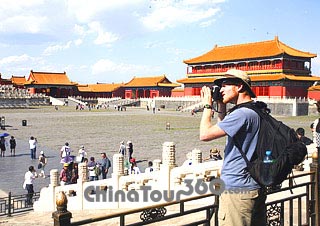
 Beijing Forbidden City Map
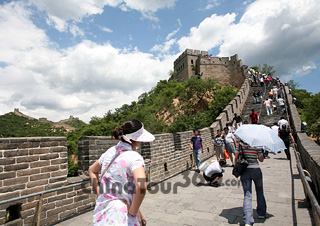 Badaling Great Wall
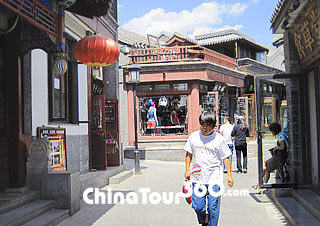 Yandaixiejie
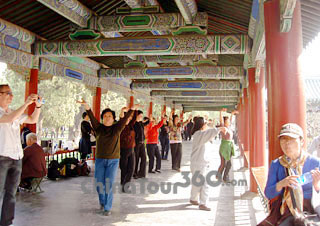 Local People
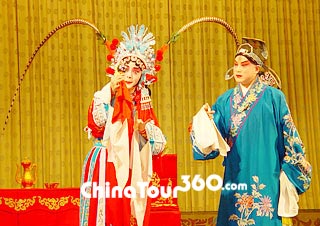 A Character of Beijing Opera
 Facts
Facts
Phone Code: 010
Postal Code: 100000
Area: 16,410.54 Sq km (6,636 Sq miles)
Population: 19,612,368 (in 2010)
Nationalities: Han, Manchu, Uygur, Chaoxian
Neighboring Areas: Tianjin City and Hebei Provinces
Location: Located at the northern end of the North China Plain, it is joined to Tianjin in the southeast, and surrounded by Hebei Province in its other parts.
Physical Features: The terrain is higher in the northwest, lower in the southeast. In the west, north and north east are continuous mountains, and in the southeast are the plain areas leaning to the Bohai Sea. The Western Hills in the west and the Jundushan Mountain in the north intersect each other at the Guangou Valley in the north of Changping District, forming a semicircular bend named 'Beijing Bend'. The plain the bend surrounds is Beijing Plain. A total of 5 rivers flow through the city from the mountains in the northwest to the plains in the southeast, including the Jumahe, Yongdinghe, Beiyunhe, Chaobaihe and Jiyunhe rivers.
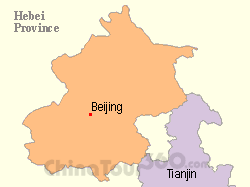 |
| Beijing Maps |
History: Founded over 3,000 years ago and as the capital city for over 857 years, it was the capital city of the vassal state Yan as early as in the Western Zhou Dynasty (11th Century - 771BC). Thereafter, it was always an important military and business town in northern China, and had been named Jicheng, Yandu, Yanjing, Zhuojun, Youzhou, Nanjing, Zhongdu, Dadu, Jingshi and Shuntianfu at various times. Since the Jin Dynasty (1115 - 1234), it has become the capital city of China. In the Ming Dynasty (1368 - 1644), the city continuously received large-scale expansions by Emperor Chengzu. The following Qing Dynasty (1644-1911) did some additional renovation and expansion works, which made it the largest city in the world at that time by the end of the Qing Dynasty.
 Recommended Tour Itineraries:
4-Day Beijing Travel: to the most popular attractions in the city
Beijing Highlight Tour: 5 Days to Tiananmen Square, Forbidden City, Temple of Heaven, Summer Palace, Badaling Great Wall, etc.
Beijing-Chengde Tour: 2 Days to Chengde Mountain Retreat & Eight Outer Temples
Beijing Attractions: Well-known as an international-level historical and cultural city, it has the most imperial palaces, gardens, temples and mausoleums in China and is also famous for having some of the most prestigious historical areas in China and the world, including:
The Forbidden City is the largest imperial palace in both China and the world.
Tiananmen Square, in front of the Forbidden City, is the largest city central square in the world.
Prince Gong's Mansion is the largest courtyard in the world.
Summer Palace is the best-preserved ancient imperial garden in China.
Ming Tombs is the largest ancient tomb group in the city, consisting of 13 emperors' tombs of the Ming Dynasty.
Beijing Great Wall, especially Badaling Great Wall, is the best-preserved Ming Dynasty great wall in China, receiving tens of thousands of visitors annually.
Peking Man Site is the most valuable site of the early Paleolithic Age in the world.
Religious architecture also enjoys a great reputation, including the Buddhist Biyun Temple (Temple of Azure Clouds), Taoist White Cloud Temple, Yonghe Palace of Lamaism, Niujie Mosque of Islam, Catholic Xishiku Church and Gangwashi Church of Christianity. There are also many natural wonders, including Beihai Park, Fragrant Hills Park, Yuyuantan Park and Purple Bamboo Garden.
Ever since China began to reform and open to the outside world, it has become a modernized international metropolis. Walking in the hutongs, you can see people from all over the world. The Business Center is the symbol of its opening up to the outside world and of its economic power. Zhongguancun is the crystal of modern technology. The National Centre for Performing Arts, T3 of Capital International Airport, CCTV Tower, Bird's Nest and Water Cube are the symbols of the modern. Many world-known universities, such as Tsinghua University and Peking University, are all located there.
Beijing Transportation:
 Air: The busiest civil aviation airport in China, Capital International Airport has opened more than 200 air routes to the major cities in the world and most cities in China.
Train: There are five major railway stations, namely Beijing Railway Station, South Railway Station, West Railway Station, North Railway Station and East Railway Station.
Bus: Centered on the city, a total of 12 national highways radiate in all directions. Buses from the 10 major long-distance bus stations of Beijing run to most of cities and areas in China, such as Guangzhou, Shanghai, Xian, Harbin and Guilin. In the city, over 800 bus routes cover every corner of the city, including the business centers, tourist attractions, hospitals, schools, markets, shopping centers, etc.
Go to Beijing Bus/Subway Search
Taxi: Taxis in the City charge a minimum fare of CNY10 for the first 2 km (1.2 miles) during the day(05:00 - 23:00) and CNY11 for the first 2.4 km (1.5 miles) at night (23:00 - 05:00). An extra CNY3 per km during the day and CNY3.4 per km at night is charged for additional distances, plus a fuel surcharge of CNY2 for a single trip.
Bicycle: Most of the hotels provide bicycle rental services. It costs around CNY5 per hour, CNY10 for a half day (usually 4 hours) and CNY20 for a whole day, after paying a deposit of around CNY400.
Rickshaw: Rickshaws add to the tourist's view of bright scenery in Hutongs. They can behired at all the communication centers and tourist hot pots.
Beijing Travel Tips: Exact addresses of some well-known restaurants, shopping centers, theaters, concert halls, cinemas, KTVs, health centers, Museums, schools and libraries.
Q&A: What is the temperature and what should I wear in November? What is the best way from the airport to Wangfujing Avenue? Which restaurant is the best in the city...... Your questions of every detail of the city will be answered.
Beijing Weather: The city has a hot and rainy summer, a dry and cold winter, and pleasing but short spring and autumn seasons. The best time to visit it is in May, September and October.
Dining
On of the 'Eight Food Cities in the world', it gathers foods from all over the world, including western countries like America, France, Italy and Germany as well as food from other Asian countries such as Japan, Korea and India. Typical dishes are Beijing Roasted Duck at Quanjuande and Bianyifang restaurants, and Imperial Court Food in Fangshan Restaurant. The local snacks have won universal praise for their long history, great variety, well-selected ingredients and elaborate preparation. Well-known local snacks are Lv Da Gun (Glutinous Rice Rolls with Sweet Bean Flour), Ai Wo Wo (Sticky Rice with Sweet Fillings) and Jiao Quan (Fried Ring). If you are not a vegetarian, Bao Du (Quick-fried Tripe), Guan Tang (Filled Sausage) and Chao Gan (Fried Live) are also worth tasting. Popular places for local snacks are Guijie located in Dongzhimen area, Donghuamen Niight Market, Wangfujing Snacks City and Longfu Temple Snacks Market.
Shopping
The only city in mainland China selected as one of the '15 Shopping Capitals in the World', it has hundreds of large and medium sized shipping malls. Wangfujing Avenue, Qianmen Dazhalan, Xidan Business Street are traditional commercial areas. International Trade City, Oriental Plaza and Zhongguancun Square are emerging business centers. If you are interested in antiques and handicrafts such as jade, ceramic, ivory carvings, seal-engraving, imperial embroidery, biyanhu (inside painting snuff bottle), dough figurines, and facial masks, the antique cities at Liulichang and Panjiayuan will appeal you. If you have a strong affection to clothing, Xiushui (Silk) Street and Yaxiu Clothing Wholesale Market can't be missed.