



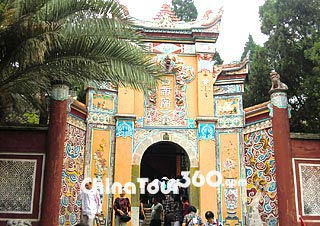
 Yangtze Baidi City
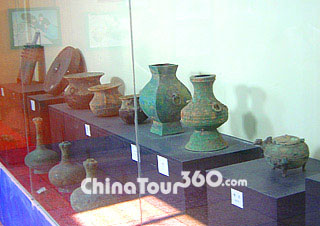 Relics in Wanzhou County
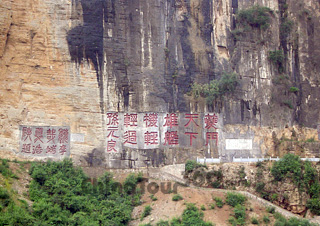 Ancient Relics aside Qutang Gorge
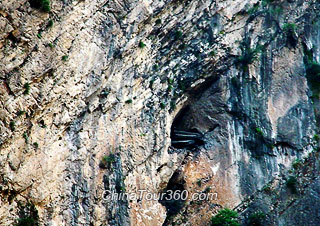 Hanging Coffin, Yangtze River
Along the Yangtze River over 620 national level cultural relics have been unearthed, including 104 historical sites, 49 ancient tombs, 259 old buildings, 59 sites of grotto temples and stone carvings, and 148 other sites. The oldest relics, at the Wushan Man Site, date back to the Stone Age of over 2 million years ago.
 Wushan Man
The site of the Wushan Man was first uncovered in Dragon’s Bone Slope (Long Gu Po), Longping Village Miaoyu Town, Wushan County, Chongqing in 1985. Archaeologists found a piece of human fossil and some fragments of bones with traces of artificial processes. After several archaeological excavations, fossil of human beings and animals, large numbers of stone implements, and traces of human activities were unearthed in the site. Surprisingly, archeologists find that the Wushan man lived about 2,040,000 years ago, which makes him the oldest human being in Asia. Some scientists even believe that the ancestors of Chinese people were from the Three Gorges area.
Yuanmou Man
Yuanmou man was excavated in Yuanmou Basin by the Jinsha River, which is one section of the Yangtze River. Some fossils of human beings, stone implements, processed animal bones, and traces of human activities were uncovered in Yuanmou, Yunnan Province in 1965. After scientific research, archeologists claimed that the Yuanmou man lived in the Paleolithic Age of about 1,700,000 years ago.
Hemudu Site
Located in the Hemudu Town, Yuyao, Zhejiang Province, the Hemudu Site is one of the earliest sites of Neolithic Period discovered in China. The site covers 50,000 square meters (5,9800 square yards) and contains four layers covering 4 different eras: the fourth layer belongs to a period of 7,000 - 6,500 years ago, the third 6,500 - 6,000 years ago, the second 6,000 - 5500 years ago, and the first belongs to a period of 5,500 - 5,000 years ago. About 7,000 pieces of relics have been unearthed in these sites, including bone wares, pottery, jade wares, wooden wares, as well as remains of rice and buildings with columns. We can imagine the prosperity of this matriarchal society of 6,000 years ago: the Hemudu people raised pigs and dogs, went out for fishing on boats, and built houses with columns.
Daxi Cultural Heritage Sites
Daxi Cultural Heritage Sites were the sites of matriarchal society in the Neolithic Period of 5,000 - 6,000 years ago and were considered one of the origins of the Yangtze River culture. The sites were first discovered in Daxi Town, eastern entrance of Qutang Gorge, Yichang, Hubei Province. In the excavation of 2007, relics of Daxi culture were also uncovered in Chongqing City. Relics discovered in these sites include stone axes, bone needles, red pottery, black pottery, grey pottery, colored pottery, jade wares, fish bones, tortoise shells, and ivory.
Liangzhu Cultural Site
Located in the Taihu Lake area of lower reach of Yangtze River, Liangzhu Cultural Site has a history of 5,300 - 4,200 years and belongs to late Neolithic Period. Large amount of exquisite relics, especially jade wares were discovered, including jade bracelets, pipes, beads, belts, and rings. A site of an ancient city of the Liangzhu cultural period was also discovered in this site, which might be the ancient capital city.
Hanging Coffins
In ancient China, some people chose to “rest” in a coffin hanging at cliffside or a cave instead of being buried underground after their death. The kind of hanging coffin has been discovered in the Three Gorges area of Yangtze River and Shanxi Province.
The hanging coffins were usually made of a whole piece of wood formed into a house or boat shape. The dead was wound in a piece of cambric and put into the coffin with his or her possessions. Most coffins were found in caves or cracks on cliffside 10 to 50 meters (33 - 164 feet) above water level, and some were even in caves 100 meters (328 feet) above water level. The tradition of handing coffin is said to have started in the Spring Autumn Period (770BC - 476BC) and lasted to the end of the Ming Dynasty (1368 - 1644). Ancient people believed that handing the coffin would make the dead closer to the heaven than burying it underground. It is still a mystery how people lifted those heavy coffins.
Other Relics
Bronze Wares: Early in the latter part of Neolithic Period, a copper smelting industry appeared in the Yangtze River basin, but bronze wares of high artistic values excavated in the area were mostly from the times of the Shang (17th - 11th Century BC) and West Zhou (11th Century - 771BC) Dynasties in central China.
Lacquer Wares: From the Warring States Period (476BC - 221BC), people lived along the Yangtze River began to produce and use lacquer wares in their daily life. Even some bronze wares were replaced by lacquer wares for their portability, durability, and smooth, rustproof, and moisture-proof surface. Lacquer cups, boxes, and decorations were widely used along the Yangtze River during the Warring States Period, especially in the Chu State (the present Hubei Province).