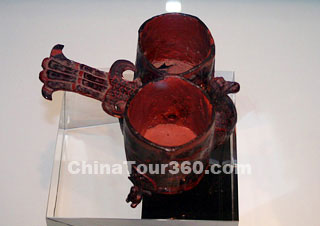


The ancients believed that their deceased ancestors would intercede on behalf of the living, provided they were honored and respected. The bronze vessels were kept in ancestral halls and used during a variety of feasts and banquets.
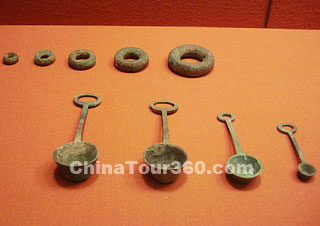
Bronze Vessels
Most bronze vessels were used for cooking food or to heat a millet wine. However, certain huge vessels usually symbolized power and status. For example, Ding, a tripod caldron, some having four legs, was originally cooking vessel and ritual vessel inscribed with memorial address, and gradually transferred into a symbol of state and power.
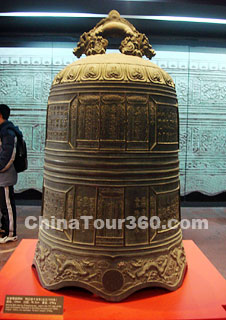 |
| An Ancient Bronze Bell |
In 1976, at Anyang in Henan Province, capital of the Shang Dynasty (17th - 11th century BC), archaeologists uncovered a Shang tomb, the burying chamber of Fuhao who was Emperor Wuding's consort and a female general who leaded troops and helped her husband in wars. The tomb was the only Shang imperial tomb found intact. Many bronze wares were found, including those she used before and those specially cast as her burial items.
Many famous Shang bronze vessels currently displayed around the world are all the legacy of Fuhao's grave. Most of the Shang vessels are shaped into animals and decorated with motifs of Taotie, a kind of legendary vicious beast and other zoomorphic designs.
Lacquer Ware
From the Shang Dynasty (17th - 11th Century BC) to the Han Dynasty (206 BC - 220 AD), colorful painting, gold inlaying and other techniques were introduced into the making of lacquer ware. The oldest one discovered dates back to the Warring State Period (403 - 221 BC) when it was popular.
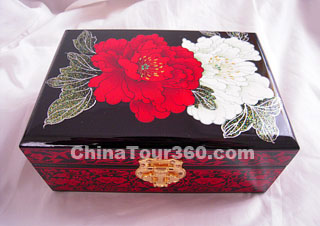
Chinese lacquer is a natural varnish made from the sap of the lacquer tree. Exposed to air, it forms a plastic coat, resistant to water, acid or alkaline corrosion. To make the ware, a base coat is applied to a core material, followed by extremely thin layers of the finest lacquer. Once these have dried, a final layer is added to make the ware strong and light, whilst maintaining the elegant appearance and harmonious color. It was in the Tang, Song and Yuan Dynasties, when the production started to flourish.
The best-known lacquer ware, which is produced in the Fujian Province, is the solid lacquer without any wooden base, characterized by its heat, acid and alkali resistant properties.
|
|