


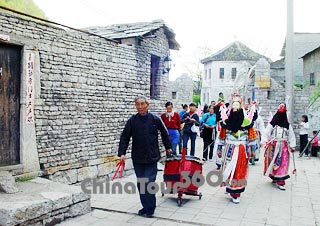
 Tianlong Tunbu
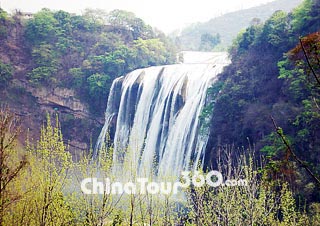 Huangguoshu Waterfall
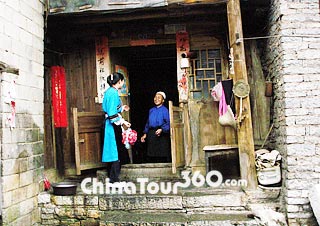 Yunshantun Village
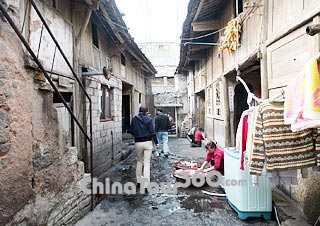 Old Houses of Tianlong Tunbu
 Jichang Village
 Facts
Facts
Phone Code: 0853
Postal Code: 561000
Area: 9,267 square kilometers (3,578 square miles)
Population: 2,297,400 (2010 statistics)
Nationality: Han, Buyi, Miao, Hui, Gelo
Location: Anshun is located in the midwest of Guizhou Province. It borders on Guiyang and Qiannan Buyi and Miao Autonomous Prefecture to the east, Liupanshui city to the west, Qianxinan Buyi and Miao Autonomous Prefecture to the south, and Bijie to the north. Anshui lies between longitude 105°15′E and 106°34′E, latitude 25°21′to 26°38′N.
Physical Features: Anshun lies at the watershed of the Yangtze River and the Pearl River, also at the center of the karst landform in South China that has the most mature and most number of karst landforms. Rivers, lakes, valleys, forests, peaks and caves are scattered around. It is estimated that there are over 100 waterfalls and more than 1,200 karst caves in the area.
History: About 2,000 years ago in the Spring and Autumn Period (770BC - 476BC), Anshun was controlled by the Zangke Kingdom, later becoming the capital of Yelang Kingdom in the Warring States Period (476BC - 221BC). After the country was unified in the Qin Dynasty (221BC – 207BC), the region was ruled by the central government. During the Ming Dynasty (1368 - 1644), the central government repressed a revolt in the south following which troops and their families should settle down as farmer in the area, Anshun being one of the regions. Groups lived together in a Tunbu (a unit, like a village) – resulting in unique Tunbu culture forms.
Attractions: Anshun boasts picturesque natural landscapes and profound cultural sites. The famous Huangguoshu Waterfall is about 45 km west of the city. Tianxing Bridge Scenic Area is close to the waterfall, comprising hills, karst caves, rivers and forest. About 28 km south of the city is the magic karst cave Dragon Palace, where you will see various shapes of stalactites and stalagmites. There is also an unusual underground park, Zhijin Cave, 100 km north of the city and a beautiful plateau lake - Red Maple Lake - 70 km east of the city.
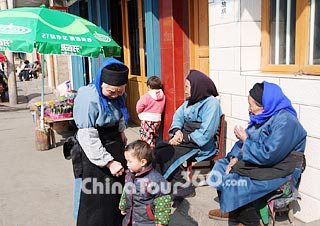
When visiting the ancient Tunbu, you will learn the unique Tunbu culture of Anshun which maintains most traditions of the Han people from the Ming Dynasty. The most famous Tunbu are Tianlong Tunbu, Yunshan Tunbu and Benzhai.
Transportation:
 Air: There are flights between Anshun and Guangzhou every Tuesday and Saturday. The Huangguoshu Airport is only 6 km from the city center.
Train: Trains from/to Beijing, Shanghai, Chongqing and Guangzhou stop at Anshun. There is also a special tourist train running between Guiyang and Anshun.
Bus: Visitors can take a bus from Guiyang Long-distance Bus Station which is located opposite Guiyang Railway Station. The bus leaves every 20 minutes. The trip takes 2 hours and bus fare is CNY 15 per person. The last bus back to Guiyang leaves at 19:10.
Anshun has two long-distance bus stations, south station and west station. The south station is near the railway station and operates buses to Guiyang, Xingyi, Zhijin, while the west station is located on Taxi Road and mainly operates buses to Guiyang, Puding and Huajiang Valley.
Buses to famous attractions, such as Huangguoshu Waterfall and Dragon Palace are available at the two bus stations and the square in front of the railway station.
Public Bus: Now 15 bus routes covers most parts of the city, among which bus No. 1, 2, 3, 4, 5, 6 and 13 pass the railway station, bus No. 1, 2, 4, 6, 7, 11 and 13 pass the south bus station, and bus No. 10, 12 and 15 pass the west bus station. The bus fare is CNY 1 – 2 per person.
Weather: Anshun has a plateau subtropical humid monsoon climate with an average annual temperature of 14°C (57.2°F). The mean temperature in July is only 21.9°C (71.4°F). The rainy season is between June and August when it rains mostly at night. There is a cool breeze from the Indian Ocean at that time, making Anshun an ideal summer resort.
Dining and Shopping
Local snacks are fried tofu ball, cool bean jelly and glutinous rice cake, which can be found at the night market at East Street, Guifu Street, and Tashan Road. There are also many restaurants in the Huangguoshu Scenic Area, serving delicious local food in a beautiful scenic setting.
Souvenir shops can be found in the city and near the bus station where visitors can buy local products, such as Anshun knives, Buyi carpet and all kinds of batik products. In the shops near scenic spots, you can also find some local products, including masks, horn combs, root carvings and tu-chung wine.
Photos: Tianlong Tunbu & Yunshan Tunbu