

24 HOURS SERVICE ( USA & CANADA )
1-800-806-0838

Great Wall

Terrain and Structure

The construction of the Wall began in the 7th century BC and continued over a period in excess of two thousand years to the 17th century (the Ming Dynasty). The materials and the technology used varied in each period depending upon the terrain, social conditions and the engineering technology at the time. But one common principle in every dynasty ensured the designer tried to make maximum use of the natural terrain such as steep mountains, river gorges or narrow passes as they built the wall using as many indigenous materials as possible.

Secrets of the Qin Wall
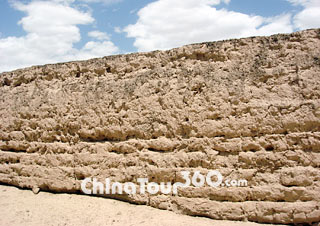
Qin Wall was built to serve as a defence system in the northern part of the empire. As it followed the ridges of steep mountains or sides of deep gorges, it served well as a mighty barrier to prevent the cavalry attack of Xiongnu. Passes, barriers and beacon towers were added to reinforce the defensive effect. In this period, the Wall was made of layers of compacted earth. The section remaining at Linzhao in today's Gansu Province is a typical example. From the exposed transverse section, scientists have found that the foundation comprises a layer of raw earth, over 1.5 meters thick at the bottom, with further loess above, some three meters thick. The wall was built on this foundation from layers of tamped-earth. The tamped-earth process began with a simple wooden frame. Workers filled the frame with loose earth, which was then tamped into a compact layer 4 inches thick. The process was repeated layer upon layer, and the wall slowly rose four inches at a time. So you can imagine how long it will take to build a seven-meter high wall. Detritus was mixed into the wall to make it more solid.

Related Links:  Wall of Qin

Secrets of the Han Wall

The Wall constructed in the Han Dynasty (206 BC- 220AD) was more massive than that in the Qin Dynasty. The Han emperors not only reinforced the Qin Wall, but also extended it from Linzhao to the west part of China where much of the terrain is deserts. This presented a new challenge: how to build a wall through the Gobi Desert? Unlike the construction during the Qin Dynasty, on the plain and in the Gobi region moats formed the main fortification. Along these moats at intervals of 1.25 kilometers, a beacon tower was built. In some regions, the mountains and rivers also served as barriers so no wall or moat was necessary but towers and castles were built in key points to ensure the continuity of the defences.

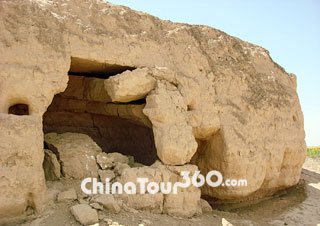
The poor quality of the sandy soil and the lack of bricks and stone give rise to the question, 'how could these towers be built in the arid Gobi Desert?' Some ruins of beacon towers in Dunhuang give us the answer. First, the workers laid a bed of red willow reeds and twigs at the bottom of a wooden frame. Then, they filled the frame with a mixture of water and fine gravel, which was tamped solid. When the mixture had thoroughly dried, the wooden frame was removed, leaving behind a solid slab of tamped earth, strengthened by the willow reeds just as modern concrete is reinforced by steel rods.

The beacon towers were constructed along the Wall at an interval of 15 to 30 miles. Columns of smoke were used to warn defenders of an attack. One smoke column meant an outpost was being threatened by a force of fewer than 500 troops and two columns meant an attacking force of fewer than 3,000. The Han found the beacon system relayed messages faster than a rider on a horse. Due to the dry climate, today in Dunhuang, you can also see the remains of these towers and even the firewood used to light the smoke.

Related Links: Wall of Han

Secrets of the Ming Wall

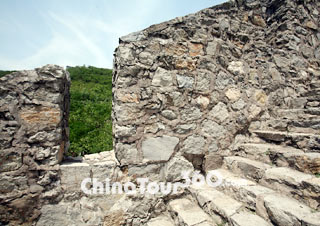
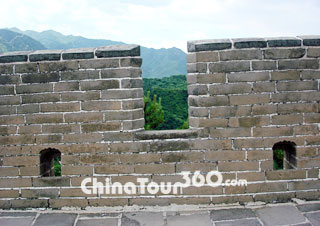
The greatest of all the wall builders were the Ming, whose astounding accomplishments dwarfed what had been done earlier by the Qin and the Han. The Ming not only built a bigger, more solid and imposing one, but also added advanced fortification structures to the Wall. The great progress made by the Ming meant that the wall was built with a tamped-earth interior between kiln-fired bricks and stone slabs forming the outer layers. The popularly toured Badaling section in Beijing is of this type. The workers mixed lime and sticky rice as a mortar between the bricks. This form of cement made the wall solid. The Ming Wall is divided by today's Shanxi Province, into the eastern part and the western part. The wall in the east winds its way along the ridges of mountains and here the wall has a facing of brick and stone while the section to the west of Shanxi, was built from tamped earth with no covering.

The construction of the military fortifications on the Wall reached its peak. More passes and reinforcements were added. Double walls were built in some military zones with strongholds and passes. For example, Juyongguan Pass, Jinziguan Pass and Daomaguan Pass are three passes built on the double walls north of Beijing. Watchtowers of various shapes and sizes served as beacons, fortresses, shelters or simply as a signal station along the wall. For example, the shelter towers were built with large interiors to store food, arms and served as the living quarters for soldiers. A staircase from the interior led up to the top of the tower. On each side of the wall were small holes for lookouts. The structure of a signal station was either round or square shaped and solid in the centre. The overall defences were enhanced with a variety of features that included the use of artillery. To this day rusting iron canons can be seen at various locations along the wall.

Related Links: Wall of Ming