


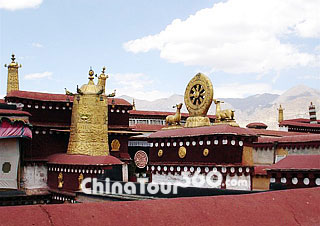
 Architecture in Jokhang Temple
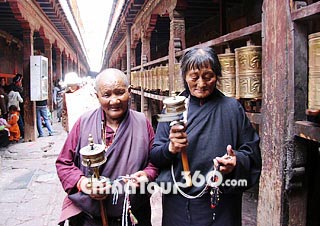 Pilgrims in Jokhang Temple
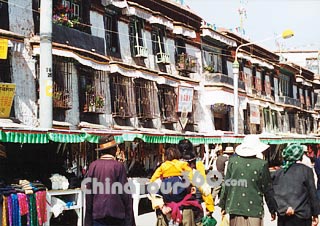 Barkor Street
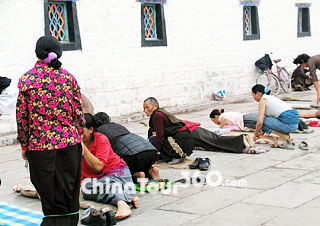 Pilgrims, Jokhang Temple
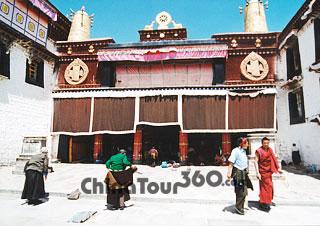 Lhasa Jokhang Temple
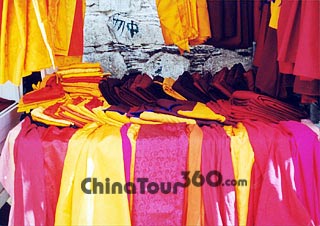 A Silk Shop in Barkor Street
Jokhang Temple is located in the southeast of the urban Lhasa with a history of over 1,300 years. It is said that the temple was built to worship the Sakyamuni's statue brought by Princess Bhrikuti Devi from Nepal. Later the statue was transferred to the Ramoche Temple, and the statue now can be seen in Jokhang Temple was brought by Princess Wencheng in the Tang Dynasty (618 - 907).
The statue of Sakyamuni is a rare treasure. When Sakyamuni was alive, he disagreed with the idea of 'personal worship' and did not allow likenesses of himself to be created. Only three statues designed by himself were permitted to be sculpted during his lifetime. The first is a likeness of him at age eight; the second shows him at age twelve when he was still a prince of India; and the third is of him as an adult. The statue kept in the Jokang Temple is the statue of Sakyamuni at age eight.
The temple is the numinous center of Tibet. Everyday pilgrim from each corner of Tibet treks a long distance to the temple. Some even progress prostration by body length to the threshold of the temple. Pilgrims fuel myriad of flickering butter lamps with yak butter, or honor their deities with white scarves (Hada) while murmuring sacred mantras to show their pieties to the Buddha. Every year, the Great Prayer Festival will be held in the Temple. The rites of Dalai Lamas and Panchen Lamas' initiation into lamahood are also held in the monastery.
Barkor Street, which has a history of over 1,000 years, surrounds the Jokhang Temple. It was originally an important route for Tibetan Buddhists to walk clockwise around to show their devotion. This religious behavior is called 'Barkor' in Tibetan Language. As one of the most bustling sections in Lhasa nowadays, Barkor Street features in sale of various kinds of handicrafts and daily necessities of local areas, India and Nepal. In addition, it has also become one of the tourism attractions for visitors both at home and abroad because of its unique historical, cultural, religious, ethnic and commercial characteristics.
Everyday, a large number of pilgrims walk clockwise around while turning their prayer wheels, lamas roam around, backpackers pass by, and tourists enjoy a moment of tranquility in bars around Barkor Street.
 Entrance Fee:
Jokhang Temple: CNY 85 ( Apr. 21 to Oct. 19) ; CNY 35 (Oct. 20 to Apr. 20 )
Barkor Street: CNY 25
Opening Hours: 09:00 - 18:00 (Jokhang Temple)
Transportation:
The temple is right in the city center, so visitors can just take a bus and get off at the Tibet Hospital or take a tricycle (CNY 4) to the temple; the Barkor Street is the street surrounding the temple.
 More Tourist Attractions in Lhasa: Potala Palace, Namtso Lake